

Not every prospective corps member goes through NYSC in exactly the same way.
Some graduates may qualify for a Certificate of Exemption, while others may receive a Letter of Exclusion. Married female PCMs may have special deployment considerations, while medical or security-related circumstances can affect deployment and service arrangements.
Foreign-trained graduates also have additional documentation and verification requirements.
If you fall into any of these categories, understanding your status before registration and mobilisation can save you from unnecessary confusion.
This guide explains the major NYSC special cases, who they apply to, the documents involved, and what you should know before proceeding.
1. NYSC Exemption: Who Can Be Exempted from Service?
An exemption means a graduate is not required to participate in the NYSC service programme and may instead receive a Certificate of Exemption.
You may qualify for exemption if you fall into any of the recognised categories, including:
You were 30 years or older at the time of graduation.
You have served in the Nigerian Armed Forces or Police for at least nine months.
You are a staff member of a security agency.
You are a part-time graduate.
Your Age Is Determined at Graduation
One important point that often causes confusion is the date used to determine age.
For the age-based exemption, what matters is your date of graduation, not the date you attend your convocation ceremony.
So, don't calculate your eligibility based on your convocation date.
What Do You Receive?
If you qualify for exemption, you receive a:
Certificate of Exemption
Your exemption status is reflected during the mobilisation process.
You can access the official NYSC portal here:
2. Exclusion Is Not the Same as Exemption
This is one of the most important distinctions PCMs should understand.
Exemption and exclusion are not the same thing.
Who Is Excluded?
The information provided for this guide identifies the following categories:
Graduates of part-time programmes
Distance learning graduates
Instead of participating in the regular NYSC service programme, eligible graduates receive a:
Letter of Exclusion
Exemption vs Exclusion
Think of it this way:
Exemption → You qualify not to serve under the applicable exemption category and receive a Certificate of Exemption.
Exclusion → Your programme type places you outside the regular NYSC service arrangement and you receive a Letter of Exclusion.
The distinction is important, so don't assume that every graduate who will not serve receives the same document.
3. Married Female PCMs: What Special Consideration Applies?
Marriage can affect the deployment considerations available to a female PCM.
A married female PCM may be considered for deployment to her husband's state of residence, subject to the applicable NYSC process and requirements.
This is why married female PCMs should ensure that their marital information and supporting documents are properly prepared during registration.
Documents You May Need
The listed supporting documents include:
Marriage certificate
Newspaper publication for change of name, where applicable
Husband's identification card
Utility bill showing the husband's residence
Husband's domicile letter
These documents should be uploaded during the online registration process where required.
Important
Don't wait until after deployment before gathering documents that may be required to support your application.
Make sure the information you provide during registration is accurate and consistent with your supporting documents.
4. Medical Conditions: When Your Health Can Affect Deployment
Some PCMs have serious medical conditions that may require special consideration during NYSC.
Depending on the circumstances and applicable NYSC procedures, medical cases may result in:
Deployment consideration
Redeployment approval
Special accommodation arrangements in camp
However, simply stating that you have a medical condition does not automatically guarantee a particular deployment outcome.
Medical claims are subject to review and verification.
Medical Documents You Should Prepare
The guide identifies the following supporting documents:
Medical report from a government hospital
Recent medical test results
Doctor's signature and stamp
Make sure your medical documentation clearly supports the condition being presented.
If your case requires special consideration, proper documentation is much more useful than relying on a verbal explanation alone.
5. Foreign-Trained Graduates Have Additional Requirements
Graduates who completed their studies outside Nigeria go through a different documentation and verification process.
If you are a foreign-trained graduate, you should pay particular attention to your documentation before mobilisation.
Documents to Prepare
The listed requirements include:
International passport
Degree certificate
Official academic transcript
O'Level results
Evaluation letter, where required
Foreign-trained graduates are also required to present their original documents during physical verification at camp.
Don't Leave Your Documents Behind
Make sure your original documents are available when required.
Having only photographs or photocopies when originals are requested can create avoidable problems during verification.
6. Security-Related Deployment Cases
NYSC deployment is also influenced by national security considerations.
Depending on the security situation, NYSC may:
Restrict deployment to certain states.
Relocate corps members from areas considered high-risk.
These decisions are made centrally for security and operational reasons.
This means a PCM should not assume that a preferred state will always be available for deployment.
Security considerations can affect deployment decisions independently of personal preference.
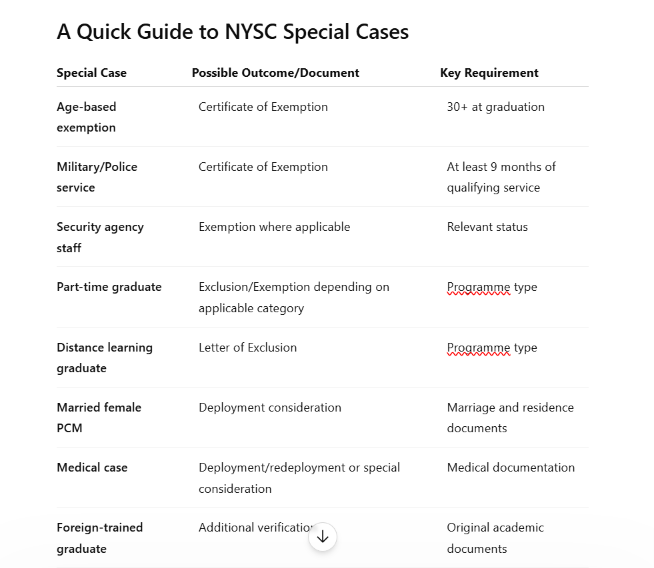
A Quick Guide to NYSC Special Cases
What Should You Do If You Fall Under a Special Case?
Don't wait until the last minute.
Follow these steps:
Step 1: Identify Your Category
Determine whether your situation relates to:
Exemption
Exclusion
Marriage
Medical circumstances
Foreign-trained qualification
Security-related deployment
Step 2: Gather Your Documents
Prepare the relevant supporting documents before you begin or complete your mobilisation process.
Step 3: Enter Your Information Correctly
Make sure your registration information agrees with your official documents.
Step 4: Upload Documents Where Required
Where NYSC requests supporting documentation during online registration, upload the appropriate documents.
Step 5: Keep Your Originals Safe
If you are required to appear for physical verification, take the original documents requested.
Step 6: Monitor Your NYSC Dashboard
Don't rely entirely on information from friends, agents or social media. Check your official NYSC status and follow the instructions applicable to your case.
Don't Confuse These NYSC Terms
These terms may sound similar, but they describe different situations:
Exemption
You are recognised as eligible for exemption from the regular service programme and receive a Certificate of Exemption.
Exclusion
You fall outside the regular NYSC service arrangement because of the applicable programme category and receive a Letter of Exclusion.
Redeployment
You have already been deployed but are subsequently approved to move to another location based on an accepted reason.
Deployment Consideration
Your circumstances may be taken into account when NYSC determines your deployment, but this does not necessarily mean a particular state is guaranteed.
Understanding these differences can prevent many common NYSC misconceptions.
Final Advice for PCMs With Special Circumstances
Having a special circumstance does not mean you should ignore the normal NYSC mobilisation process.
The safest approach is to:
Know your category → prepare your documents → provide accurate information → follow the official procedure → keep checking your NYSC status.
Most importantly, don't rely on assumptions or promises from third parties when your mobilisation status is involved.
If your case involves exemption, exclusion, marriage, medical circumstances, foreign training or security-related deployment, make sure you understand the requirements that apply to your specific situation before taking the next step.
Your NYSC journey may be different from that of another PCM, but with the right information and documentation, you can navigate the process with far less confusion.